
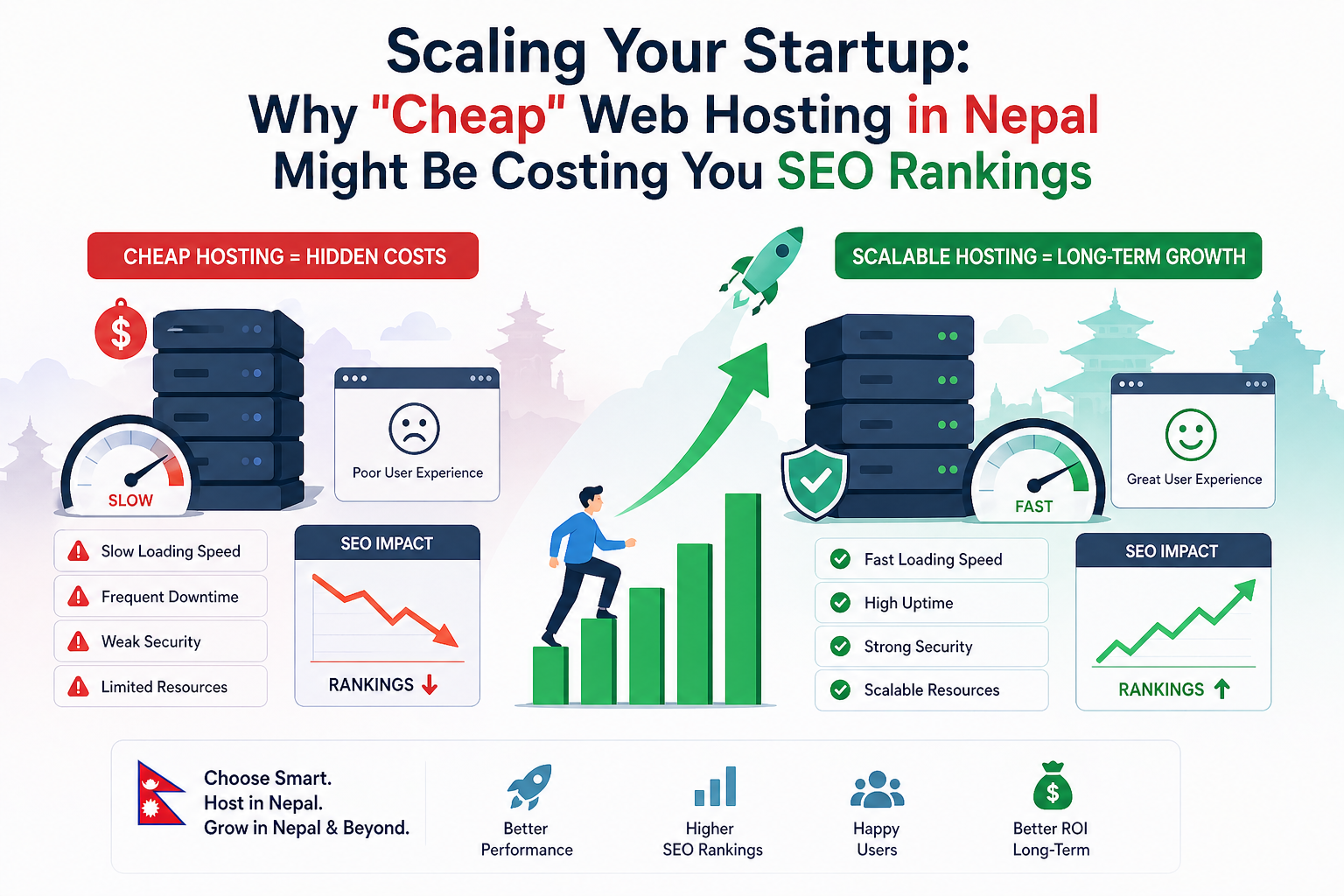
- You are spending NRS 30,000/month on SEO content but hosting your site on a NRS 800/year shared plan.
- Every piece of content you publish is handicapped from day one.
- Here is the data that proves cheap hosting directly kills your search rankings.
Nepal’s startup ecosystem is growing faster than ever. Founders are focusing on what truly matters—building products, acquiring customers, and scaling their business.
But there’s one critical decision that is still being treated like a minor checkbox:
👉 web hosting
For many startups, hosting is seen as a commodity:
“Just pick the cheapest plan and move on.”
This mindset is quietly costing businesses thousands of rupees every month in lost traffic, poor rankings, and missed revenue opportunities.
Because in 2026, your hosting is no longer just infrastructure—it’s a core SEO ranking factor.
How Google Really Measures Your Website Performance
Gone are the days when SEO was only about keywords and backlinks.
Today, Google evaluates your website based on real user experience, using performance signals collected from actual visitors.
Through updates like Core Web Vitals and Page Experience, Google measures:
1. Largest Contentful Paint (LCP)
This measures how quickly the main content of your page loads—such as a banner image or headline.
- ✅ Target: Under 2.5 seconds
- 🔧 Influenced by: Server speed, hosting quality, image delivery
A slow server means your content takes longer to appear, frustrating users instantly.
2. Interaction to Next Paint (INP)
INP tracks how responsive your site is when a user interacts—clicking a button, filling a form, or navigating pages.
- ✅ Target: Under 200 milliseconds
- 🔧 Influenced by: Backend speed, server response time
If your server is slow, every interaction feels delayed.
3. Cumulative Layout Shift (CLS)
This measures visual stability—whether elements jump around while loading.
- ✅ Target: Below 0.1
While design plays a role, slow loading assets can also worsen this experience.
4. Time to First Byte (TTFB)
This measures how quickly your server responds when a user requests your site.
- ✅ Target: Under 800 milliseconds
👉 This is the most direct indicator of hosting quality.
The Reality: Cheap Hosting = Poor Performance
Low-cost hosting—especially when servers are located far from Nepal—almost always results in:
- High TTFB (slow server response)
- Slow LCP (delayed content loading)
- Poor Core Web Vitals scores
And when that happens:
👉 Google ranks faster, better-performing competitor websites above yours—even if your content is superior.
The Real Cost of Slow Hosting (Not Just Technical—Financial)
Let’s look at a real-world comparison based on actual migration data:
| Scenario | Monthly Visitors | Conversion Rate | Revenue |
|---|---|---|---|
| Fast Hosting (LCP 1.8s) | 8,000 | 3.2% | NPR 1,92,000 |
| Slow Hosting (LCP 4.5s) | 4,200 | 1.9% | NPR 59,850 |
Monthly Impact:
- ❌ Loss of 3,800 visitors
- ❌ Drop of 1.3% conversion rate
- ❌ Revenue loss of NPR 1,32,150
Nothing else changed:
- Same content
- Same SEO efforts
- Same business
👉 The only difference was hosting performance
7 Hidden Ways Cheap Hosting Damages Your SEO
1. Shared IP Reputation Risk
Cheap hosting places hundreds of websites on a single IP.
If even one site:
- Sends spam
- Gets hacked
- Hosts malware
Your IP can be blacklisted.
This impacts:
- Email delivery
- Google trust
- Search rankings
2. Downtime Hurts Google Crawling
Low-cost hosts often experience:
- 2–8 hours of downtime per month
When Googlebot visits during downtime:
- It sees errors
- Marks your site as unreliable
Repeated failures reduce your ranking over time.
3. No Modern Protocols (HTTP/2 & HTTP/3)
Outdated hosting still uses HTTP/1.1.
Modern protocols:
- Load multiple assets simultaneously
- Improve page speed significantly
Without them:
👉 Your site feels slower—even if content is optimized.
4. Missing Brotli Compression
Most cheap hosts only support gzip.
But Brotli compression:
- Reduces file size by 15–25% more
- Is supported by modern browsers
Without it:
👉 Your site sends larger files → slower loading
5. Oversold Servers = Unpredictable Speed
Cheap providers overload servers with too many users.
Result:
- Slowdowns during peak hours
- Random lag spikes
- Inconsistent performance
Google records these variations—and your rankings suffer.
6. No Staging Environment
Without staging:
- Updates happen directly on your live site
- Errors can break your website instantly
If Google indexes your site during that time:
👉 Your SEO is immediately affected.
7. Limited PHP Workers
PHP workers control how many requests your server can handle.
Cheap hosting:
- Limits to 4–8 workers
During traffic spikes:
- Requests queue up
- Site slows down or crashes
Exactly when you get traffic—you lose performance.
What High-Performance Hosting Should Look Like
If you want to grow your startup, your hosting must support scale.
A proper setup includes:
- LiteSpeed server (much faster than Apache)
- HTTP/2 and HTTP/3 support
- Brotli + gzip compression
- 30–50+ PHP workers
- Redis caching
- NVMe SSD storage
- 99.9% uptime guarantee
- Local or nearby server (Nepal/India)
This combination ensures:
- Fast loading speeds
- Better Core Web Vitals
- Higher Google rankings
Why Server Location Matters for Nepal
Distance affects speed.
- USA/Europe servers → High latency
- Singapore → Moderate latency
- Nepal/India → Low latency
Lower latency means:
- Faster server response
- Better user experience
- Improved SEO
For Nepali audiences, local hosting gives you a real competitive advantage.
Final Thought: Hosting Is Your SEO Foundation
Startups often invest heavily in:
- SEO agencies
- Content marketing
- Paid ads
But ignore the one factor that affects everything:
👉 website performance
No matter how good your strategy is, it cannot overcome a slow server.
Your hosting determines:
- How fast your site loads
- How users interact with it
- How Google ranks it
Stop Losing Traffic Due to Slow Hosting
If your website feels slow—even slightly—you are already losing:
- Rankings
- Visitors
- Revenue
High-performance hosting is not a luxury—it’s a necessity.
Get a Free Website Performance Audit
WebsNP provides startup-focused hosting optimized for:
- Core Web Vitals
- Nepal-based performance
- Scalability and growth
👉 Request a free Core Web Vitals audit today and find out exactly how much your hosting is costing your business.